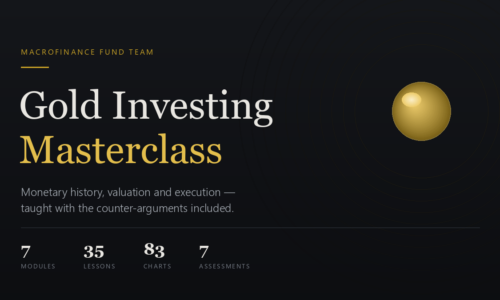
Gold has been money for four and a half thousand years and a bad investment for entire decades. This masterclass teaches you to tell which of those is happening — and what to do about it.
What this course is
A seven-module programme covering monetary history, the mechanics of currency creation, the analytical tools for valuing gold against other assets, portfolio construction, practical execution, and the question almost nobody teaches: when to sell.
It is built for people who want to understand the argument well enough to hold a position through a 40% drawdown — or to decline the position for reasons they can articulate. Both are legitimate outcomes of taking this course seriously.
What makes it different
Most precious metals education is written by people selling precious metals. It shows you the chart that starts in 1971 and never the one that starts in 1980. It promises that gold always rises, which is false, and it treats scepticism as a failure of nerve rather than as analysis.
This course does the opposite. Every module contains a section arguing the strongest available case against the position being taught. You will learn why every country abandoned the gold standard under pressure rather than by conspiracy, why the 2009–2019 inflation forecasts were wrong in mechanism and not merely in timing, and why an all-gold portfolio would have badly underperformed a balanced one over the last sixteen years.
Conviction that cannot survive the counter-argument is not conviction. It is exposure.
Course structure
| Module | Focus |
|---|---|
| 1 — Money, Currency & Purchasing Power | The analytical vocabulary: money versus currency, what fiat means, monetary versus price inflation, the Cantillon effect, how money is really created |
| 2 — Four Thousand Years of Evidence | Athens and Rome, the great manias, Weimar, the American arc from 1913 to 1971, and the 30–40 year monetary regime clock |
| 3 — The System As It Stands | Debt and unfunded liabilities, reserve currency mechanics, how CPI is constructed, derivatives and counterparty chains, the post-2022 central bank gold shift |
| 4 — Price vs Value | Measuring in real things: the Dow/gold ratio, the gold/silver ratio, housing and oil priced in gold, monetary coverage models and their limits |
| 5 — Cycles, Scenarios & Portfolio | The paper/hard-asset pendulum, how gold actually behaved in four macro regimes, position sizing, gold versus silver, miners and leverage |
| 6 — Execution | Vehicle selection, choosing physical product, dealer due diligence, storage, the scams, and tax and reporting |
| 7 — The Exit & Your Plan | When to sell, building a written investment plan, rebalancing rules, and your allocation blueprint |
How to work through it
Each lesson pairs a slide deck with a written article covering the same ground in more depth. The decks are navigable with arrow keys and open full screen. Every chart is generated from the underlying data rather than reproduced, and every figure is sourced.
Each module ends with an assessment. The pass mark is 70% and retakes are unlimited. The assessments exist because later modules genuinely build on earlier ones — Module 4 is unreadable without Module 1’s distinction between price and value.
Most lessons close with a short exercise applied to your own finances. Doing them is the difference between finishing the course informed and finishing it changed.
This course is educational material. It is not investment, tax or legal advice, and it does not account for your circumstances, objectives or risk tolerance. Precious metals are volatile and can fall substantially; gold remained below its 1980 peak in real terms for roughly twenty-eight years. Nothing here is a recommendation to buy or sell any asset. Consult a qualified, independent professional before acting on anything you read.
Gold Investing Masterclass · Prepared by the MacroFinance Fund Team.
Curriculum
- 7 Sections
- 35 Lessons
- 8 Weeks
- Module 1 — Money, Currency & Purchasing PowerThe analytical vocabulary the rest of the course assumes. Five lessons on what money actually is, what fiat means, why inflation is not the same thing as rising prices, who receives newly created currency first, and how money is really created and destroyed.6
- Module 2 — Four Thousand Years of EvidenceFive case studies in monetary failure and recovery: the debasements of Athens and Rome, the tulip and Mississippi manias, the Weimar hyperinflation, the American arc from the Federal Reserve to the closing of the gold window, and the question of whether monetary regimes run on a clock.6
- Module 3 — The System As It StandsThe present-day monetary system, examined without exaggeration: sovereign debt and the promises attached to it, how reserve currency status actually works, how inflation is measured and where the popular criticisms fail, the real location of financial fragility, and the central bank gold buying that began in 2010 and accelerated after 2022.6
- Module 4 — Price vs ValueThe analytical toolkit. Six ways to measure gold against real things rather than against a currency whose own value is changing — the Dow/gold ratio, the gold/silver ratio, housing, oil, wages and monetary coverage — together with the discipline for handling the fact that these measures frequently disagree with one another.6
- Module 5 — Cycles, Scenarios & PortfolioFrom analysis to a number. The paper/hard-asset pendulum and its limits, how gold actually behaved across four macro regimes including the two decades it lost badly, position sizing derived from tolerable drawdown rather than conviction, the real cost of silver, and why mining shares have underperformed the metal for twenty years.6
- Module 6 — ExecutionTurning a decision into a holding without losing several percent along the way. Choosing a vehicle from your actual purpose, selecting physical product without paying for divisibility you will never use, vetting a dealer in twenty minutes, storing metal so you actually own the protection, recognising the scams, and keeping the records that protect your cost basis.7
- Module 7 — The Exit & Your PlanThe half of the subject almost nobody teaches. When to sell and what to buy with the proceeds, how to write a plan that survives being wrong for a decade, the rebalancing rules and behavioural failures that decide whether you hold the position at all, and a capstone that assembles every earlier exercise into a single page.5
Instructor

Our finance and AI team builds and maintains tools for portfolio management, financial and economic research, and AI. These courses come from that same work: step-by-step lessons with worked examples and real data. Educational material only; not investment advice.
Gold Investing Masterclass: frequently asked questions
Is gold a good investment?
It has been money for thousands of years and a poor investment for entire decades. The course teaches you to judge which regime you are in, with the strongest case against gold argued in every module.
How much does Gold Investing Masterclass cost?
Gold Investing Masterclass costs $199.
How long does Gold Investing Masterclass take?
It is designed to be completed in about 8 weeks, at your own pace.
What level is Gold Investing Masterclass?
The course is rated all levels level.
Is this financial advice?
No. The course is educational only and is not personal financial advice.