A step-by-step course in building a systematic multi-asset trading strategy, from the arithmetic of returns to a risk-managed book you could actually run. No programming is required: every formula is worked through numerically, so a learner with a spreadsheet can follow every calculation.
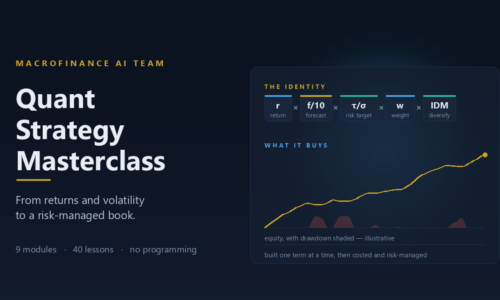
The course assembles a single position-sizing identity one term at a time. It begins with how a strategy is measured — returns, volatility, Sharpe, skew, tails and drawdown — and with the data questions that decide a result before any rule is written. It then builds the strategy itself: a held position, a risk target, a rolling volatility estimate, a diversified portfolio, trend and carry forecasts, and the multipliers that combine them. Trading costs are then imposed as the binding constraint they are, and the fitting discipline that separates a research result from a tradeable one is set out in full.
A dedicated module covers risk management: volatility targeting and the growth-optimal bet size, risk per position, measuring the risk environment, what correlation does in a crisis, tail risk and drawdown control, and the limits that cap leverage. The course closes with the daily operating routine, a complete reference framework, and a final examination.
Prepared by the MacroFinance AI Team. Educational material only; nothing here is investment advice, and no past or illustrative performance figure should be read as a prediction.
Curriculum
- 11 Sections
- 46 Lessons
- 9 Weeks
- Module 1 — How a Strategy Is MeasuredBefore building anything, the vocabulary of judgement: what a systematic strategy is, how returns and volatility are annualised, what a Sharpe ratio can and cannot tell you, and the two properties — skew and drawdown — that a Sharpe ratio hides entirely.10
- 1.1L01 — What a Systematic Strategy Is45 Minutes
- 1.2L01 Quiz — What a Systematic Strategy Is12 Minutes9 Questions
- 1.3L02 — Returns, Volatility and Annualisation50 Minutes
- 1.4L02 Quiz — Returns, Volatility and Annualisation12 Minutes9 Questions
- 1.5L03 — The Sharpe Ratio and Its Ceilings55 Minutes
- 1.6L03 Quiz — The Sharpe Ratio and Its Ceilings12 Minutes9 Questions
- 1.7L04 — Skew and Tails55 Minutes
- 1.8L04 Quiz — Skew and Tails12 Minutes9 Questions
- 1.9L05 — Drawdown, Path and Distribution45 Minutes
- 1.10L05 Quiz — Drawdown, Path and Distribution12 Minutes9 Questions
- Module 2 — Data Before Anything ElseMost backtests are wrong before a single rule is written. What a price series actually contains, how futures series are stitched together and what that bakes in, how to assemble a universe, and the handful of errors that make an impressive result untradeable.8
- 2.1L06 — What Your Price Series Actually Contains55 Minutes
- 2.2L06 Quiz — What Your Price Series Actually Contains12 Minutes9 Questions
- 2.3L07 — Futures: Back-adjustment, Rolls and Embedded Carry55 Minutes
- 2.4L07 Quiz — Futures: Back-adjustment, Rolls and Embedded Carry12 Minutes9 Questions
- 2.5L08 — Choosing Instruments and Building a Universe50 Minutes
- 2.6L08 Quiz — Choosing Instruments and Building a Universe12 Minutes9 Questions
- 2.7L09 — Look-ahead and the Integrity of a Backtest50 Minutes
- 2.8L09 Quiz — Look-ahead and the Integrity of a Backtest12 Minutes9 Questions
- Module 3 — The Position-Sizing IdentityThe first four steps of the build, each one adding a term to the identity: a single held position, a fixed risk target, a rolling volatility estimate, and finally a portfolio with instrument weights and the multiplier that restores the risk diversification removes.8
- 3.1L10 — Step One: Buy and Hold a Single Instrument50 Minutes
- 3.2L10 Quiz — Step One: Buy and Hold a Single Instrument12 Minutes9 Questions
- 3.3L11 — Step Two: Scaling to a Fixed Risk Target55 Minutes
- 3.4L11 Quiz — Step Two: Scaling to a Fixed Risk Target12 Minutes9 Questions
- 3.5L12 — Step Three: Rolling Volatility and Variable Scaling55 Minutes
- 3.6L12 Quiz — Step Three: Rolling Volatility and Variable Scaling12 Minutes9 Questions
- 3.7L13 — Step Four: A Portfolio, Instrument Weights and the IDM60 Minutes
- 3.8L13 Quiz — Step Four: A Portfolio, Weights and the IDM12 Minutes9 Questions
- Module 4 — Forecasts: From View to PositionAdding the forecast term. What a scaled forecast is, the trend family that does most of the work in most systematic books, how to move from a binary filter to a continuous conviction, and how to combine several rules without losing the risk you were aiming for.8
- 4.1L14 — What a Forecast Is, and How It Is Scaled50 Minutes
- 4.2L14 Quiz — What a Forecast Is, and How It Is Scaled12 Minutes9 Questions
- 4.3L15 — Trend: The Moving-Average Crossover Family55 Minutes
- 4.4L15 Quiz — Trend: The Moving-Average Crossover Family12 Minutes9 Questions
- 4.5L16 — From Binary to Scaled, and Across Speeds55 Minutes
- 4.6L16 Quiz — From Binary to Scaled, and Across Speeds12 Minutes9 Questions
- 4.7L17 — Combining Rules and the Forecast Diversification Multiplier55 Minutes
- 4.8L17 Quiz — Combining Rules and the Forecast Diversification Multiplier12 Minutes9 Questions
- Module 5 — Return Sources Beyond TrendTrend alone is one bet. Carry, the skew premium and the cross-sectional versions of both add genuinely different sources — and this module is equally about knowing when adding another rule stops helping and starts diluting.8
- 5.1L18 — Carry55 Minutes
- 5.2L18 Quiz — Carry12 Minutes9 Questions
- 5.3L19 — The Skew Premium50 Minutes
- 5.4L19 Quiz — The Skew Premium12 Minutes9 Questions
- 5.5L20 — Cross-Sectional Momentum and Carry50 Minutes
- 5.6L20 Quiz — Cross-Sectional Momentum and Carry12 Minutes9 Questions
- 5.7L21 — Value, Breakout and the Saturation Point55 Minutes
- 5.8L21 Quiz — Value, Breakout and the Saturation Point12 Minutes9 Questions
- Module 6 — Costs and the Speed LimitThe binding constraint on every system in this course. What a trade costs, how to convert turnover into Sharpe lost, the rule that caps how fast you may trade, and the reckoning that reverses the ranking of everything built so far.8
- 6.1L22 — What a Trade Actually Costs50 Minutes
- 6.2L22 Quiz — What a Trade Actually Costs12 Minutes9 Questions
- 6.3L23 — Turnover, Cost-in-Sharpe and the Speed Limit55 Minutes
- 6.4L23 Quiz — Turnover, Cost-in-Sharpe and the Speed Limit12 Minutes9 Questions
- 6.5L24 — Buffering and Position Inertia45 Minutes
- 6.6L24 Quiz — Buffering and Position Inertia12 Minutes9 Questions
- 6.7L25 — The Net-of-Cost Reckoning55 Minutes
- 6.8L25 Quiz — The Net-of-Cost Reckoning12 Minutes9 Questions
- Module 7 — Fitting Without Fooling YourselfThe discipline that separates a research result from a tradeable one: why in-sample testing is dishonest, why blending beats selecting, why hand-built weights beat optimised ones, and how much of a backtest number to believe.8
- 7.1L26 — Over-fitting and the Dishonesty of In-Sample55 Minutes
- 7.2L26 Quiz — In-Sample, Out-of-Sample and the Cost of Hindsight12 Minutes9 Questions
- 7.3L27 — Blend, Don’t Select50 Minutes
- 7.4L27 Quiz — Blend, Don’t Select12 Minutes9 Questions
- 7.5L28 — Allocation: Handcrafting Beats Optimising55 Minutes
- 7.6L28 Quiz — Allocation: Handcrafting Beats Optimising12 Minutes9 Questions
- 7.7L29 — Pessimism, Sample Size and the Red-Flag Scorecard50 Minutes
- 7.8L29 Quiz — Pessimism, Sample Size and the Red-Flag Scorecard12 Minutes9 Questions
- Module 8 — Risk Management ModelsThe overlay that sits above everything else: how much risk to run and why, how much to put on any single bet, how to measure the environment, what happens to correlation exactly when you need it most, and how to bound the tail.12
- 8.1L30 — Volatility Targeting and the Kelly Criterion60 Minutes
- 8.2L30 Quiz — Volatility Targeting and the Kelly Criterion12 Minutes9 Questions
- 8.3L31 — Risk per Bet, Stops and Position Limits55 Minutes
- 8.4L31 Quiz — Risk per Bet, Stops and Position Limits12 Minutes9 Questions
- 8.5L32 — Risk Regimes: Measuring the Environment60 Minutes
- 8.6L32 Quiz — Risk Regimes: Measuring the Environment12 Minutes9 Questions
- 8.7L33 — Correlation Risk and the Myth of Diversification55 Minutes
- 8.8L33 Quiz — Correlation Risk and the Myth of Diversification12 Minutes9 Questions
- 8.9L34 — Tail Risk and Drawdown Control55 Minutes
- 8.10L34 Quiz — Tail Risk and Drawdown Control12 Minutes9 Questions
- 8.11L35 — Leverage, Capital and the Four Limits50 Minutes
- 8.12L35 Quiz — Leverage, Capital and the Four Limits12 Minutes9 Questions
- Module 9 — Running It, and a Complete Worked FrameworkFrom a tested design to a system you operate: the daily routine, what to monitor and when to stop. Then a complete reference framework assembled from every part of the course, and the final consolidation.8
- 9.1L36 — The Daily Routine55 Minutes
- 9.2L36 Quiz — The Daily Routine12 Minutes9 Questions
- 9.3L37 — Monitoring, Degradation and When to Stop50 Minutes
- 9.4L37 Quiz — Monitoring, Degradation and When to Stop12 Minutes9 Questions
- 9.5L38 — A Complete Framework I: Objectives, Universe and Return Sources55 Minutes
- 9.6L38 Quiz — A Complete Framework I: Objectives, Universe and Return Sources12 Minutes9 Questions
- 9.7L39 — A Complete Framework II: The Risk Overlay and Regime Switching55 Minutes
- 9.8L39 Quiz — A Complete Framework II: The Risk Overlay and Regime Switching12 Minutes9 Questions
- Module 10 — Beyond Trend and CarryOptional extensions, once the core build is running cleanly: implementing a large design on small capital, a genuinely different return source, relative value, the standard refinements to the trend rules, calendar effects — and a scale for deciding which of them, if any, is worth its complexity.12
- 10.1L40 — Dynamic Optimisation: A Large Portfolio on Small Capital60 Minutes
- 10.2L40 Quiz — Dynamic Optimisation: A Large Portfolio on Small Capital12 Minutes9 Questions
- 10.3L41 — Fast Mean Reversion55 Minutes
- 10.4L41 Quiz — Fast Mean Reversion12 Minutes9 Questions
- 10.5L42 — Relative Value: Spreads and Triplets55 Minutes
- 10.6L42 Quiz — Relative Value: Spreads and Triplets12 Minutes9 Questions
- 10.7L43 — Refining the Trend Rules50 Minutes
- 10.8L43 Quiz — Refining the Trend Rules12 Minutes9 Questions
- 10.9L44 — Seasonality and Calendar Effects50 Minutes
- 10.10L44 Quiz — Seasonality and Calendar Effects12 Minutes9 Questions
- 10.11L45 — Choosing What to Add55 Minutes
- 10.12L45 Quiz — Choosing What to Add12 Minutes9 Questions
- Module 11 — The Complete BuildThe whole course assembled into one build sequence: the master identity with every term now derived, the ten stages in the order they must happen, the constants worth knowing by heart, and a three-part checklist to run against your own design.2
Instructor

Our finance and AI team builds and maintains tools for portfolio management, financial and economic research, and AI. These courses come from that same work: step-by-step lessons with worked examples and real data. Educational material only; not investment advice.
Quant Strategy Masterclass: frequently asked questions
Do I need to code?
No. Every formula is worked through numerically, so a learner with a spreadsheet can follow each calculation.
How much does Quant Strategy Masterclass cost?
Quant Strategy Masterclass costs $1,000.
How long does Quant Strategy Masterclass take?
It is designed to be completed in about 9 weeks, at your own pace.
What level is Quant Strategy Masterclass?
The course is rated intermediate level.
Is this financial advice?
No. The course is educational only and is not personal financial advice.