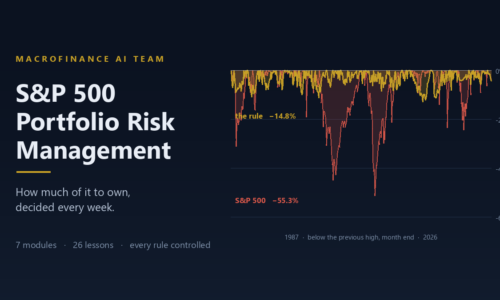
One market, one decision, repeated every week: how much of the S&P 500 do you own right now? This is an applied course in managing the risk of a single equity position — for investors, allocators and portfolio managers who intend to hold the index for decades and would rather not sit through every one of its drawdowns at full size. It assumes comfort with markets, not with mathematics: the formulas that matter are shown, and each one is explained in words beside it.
It starts with what buy-and-hold actually costs, measured rather than asserted, and with the benchmarks and conventions that decide whether a risk rule has done anything at all. It then builds the rule from closing prices upward: a trend score, a momentum score, a cross-asset stress reading, an entry and exit condition that is deliberately asymmetric, and a position size that moves continuously rather than switching on and off. Module 5 asks what to hold when equities are not the answer, and why a fixed bond allocation stopped working in 2022. Module 6 is the part that separates a strategy from a backtest — four controls, a measured noise floor, and four worked cases of rules that looked good and were not. Module 7 reduces the whole thing to a weekly routine.
Every figure is computed from the S&P 500’s own record between 1987 and the present, including the 1987 crash, the Gulf war, LTCM, the dot-com bear market, the global financial crisis, the eurozone crisis, 2018, COVID, 2022 and 2025. Around a third of the material is rules that failed, and why. Every lesson ships a slide deck, a written script and an assessment.
Prepared by the MacroFinance AI Team. Educational material only; nothing here is investment advice.
Curriculum
- 7 Sections
- 26 Lessons
- 7 Weeks
- Module 1 — The Problem With Owning the S&P 500What a passive position in this index actually costs, what a risk rule would have to optimise, what to compare one against, and why the simple rules everybody already knows mostly disappoint.8
- 1.1L01 — What Buy-and-Hold Actually Costs45 Minutes
- 1.2L01 Quiz — What Buy-and-Hold Actually Costs12 Minutes9 Questions
- 1.3L02 — What We Are Actually Optimising45 Minutes
- 1.4L02 Quiz — What We Are Actually Optimising12 Minutes9 Questions
- 1.5L03 — Two Honest Benchmarks45 Minutes
- 1.6L03 Quiz — Two Honest Benchmarks12 Minutes9 Questions
- 1.7L04 — Why Simple Risk Rules Disappoint50 Minutes
- 1.8L04 Quiz — Why Simple Risk Rules Disappoint12 Minutes9 Questions
- Module 2 — Measuring the Market You OwnFour measurements built from closing prices alone, each with a worked example on real dates: how unusual today is, where the trend is, where momentum is, and why the two must be allowed to disagree.8
- 2.1L05 — The z-Score and the Rolling Window45 Minutes
- 2.2L05 Quiz — The z-Score and the Rolling Window12 Minutes9 Questions
- 2.3L06 — Trend: Eight Questions45 Minutes
- 2.4L06 Quiz — Trend: Eight Questions12 Minutes9 Questions
- 2.5L07 — Momentum: Four Questions45 Minutes
- 2.6L07 Quiz — Momentum: Four Questions12 Minutes9 Questions
- 2.7L08 — Combining Them, and Why They Must Disagree45 Minutes
- 2.8L08 Quiz — Combining Them, and Why They Must Disagree12 Minutes9 Questions
- Module 3 — Risk Lives Across MarketsThe S&P 500 is not an island. Correlation as a regime rather than a number, the matrix in calm and in stress, where stress shows up first, and how to compress five markets into one reading.8
- 3.1L09 — Correlation Is a Regime, Not a Number50 Minutes
- 3.2L09 Quiz — Correlation Is a Regime, Not a Number12 Minutes9 Questions
- 3.3L10 — The Matrix in Calm and in Stress50 Minutes
- 3.4L10 Quiz — The Matrix in Calm and in Stress12 Minutes9 Questions
- 3.5L11 — Where Stress Shows Up First45 Minutes
- 3.6L11 Quiz — Where Stress Shows Up First12 Minutes9 Questions
- 3.7L12 — Building a Cross-Asset Stress Index50 Minutes
- 3.8L12 Quiz — Building a Cross-Asset Stress Index12 Minutes9 Questions
- Module 4 — From Signal to PositionThe decision rule itself, assembled one piece at a time: why a bare threshold flickers, what asymmetric entry and exit buy, how to size continuously, and the finished rule walked through two crises day by day.8
- 4.1L13 — Thresholds Flicker45 Minutes
- 4.2L13 Quiz — Thresholds Flicker12 Minutes9 Questions
- 4.3L14 — Hysteresis: Slow In, Fast Out45 Minutes
- 4.4L14 Quiz — Hysteresis: Slow In, Fast Out12 Minutes9 Questions
- 4.5L15 — The Stress Ladder50 Minutes
- 4.6L15 Quiz — The Stress Ladder12 Minutes9 Questions
- 4.7L16 — The Complete Rule, Step by Step55 Minutes
- 4.8L16 Quiz — The Complete Rule, Step by Step12 Minutes9 Questions
- Module 5 — The Other Side of the TradeWhat you hold when you are not holding equities. Why a fixed bond allocation is a standing bet on a correlation, what to do instead, and which safe havens survive examination.6
- 5.1L17 — Cash Is Not Free, Bonds Are Not Safe45 Minutes
- 5.2L17 Quiz — Cash Is Not Free, Bonds Are Not Safe12 Minutes9 Questions
- 5.3L18 — The Gated Risk-Off Leg50 Minutes
- 5.4L18 Quiz — The Gated Risk-Off Leg12 Minutes9 Questions
- 5.5L19 — Safe Havens That Are Not45 Minutes
- 5.6L19 Quiz — Safe Havens That Are Not12 Minutes9 Questions
- Module 6 — Proving It Isn't LuckThe part that separates a strategy from a backtest, taught through four failures: how large a difference has to be, the four controls, a rule that provably cannot work, and an effect that passes everything and is still wrong.8
- 6.1L20 — The Noise Floor50 Minutes
- 6.2L20 Quiz — The Noise Floor12 Minutes9 Questions
- 6.3L21 — Four Controls Every Rule Must Pass50 Minutes
- 6.4L21 Quiz — Four Controls Every Rule Must Pass12 Minutes9 Questions
- 6.5L22 — When the Rule Cannot Do What You Want45 Minutes
- 6.6L22 Quiz — When the Rule Cannot Do What You Want12 Minutes9 Questions
- 6.7L23 — Regime Artefacts50 Minutes
- 6.8L23 Quiz — Regime Artefacts12 Minutes9 Questions
- Module 7 — Running ItFrom a backtest to a Monday morning: the weekly procedure, the costs that a backtest does not charge you, and a final assessment across the whole course.6
- 7.1L24 — The Weekly Routine45 Minutes
- 7.2L24 Quiz — The Weekly Routine12 Minutes9 Questions
- 7.3L25 — Costs, Slippage, Tax and the Real Account45 Minutes
- 7.4L25 Quiz — Costs, Slippage, Tax and the Real Account12 Minutes9 Questions
- 7.5L26 — Final Examination45 Minutes
- 7.6L26 Quiz — Final Examination58 Minutes46 Questions
Instructor

Our finance and AI team builds and maintains tools for portfolio management, financial and economic research, and AI. These courses come from that same work: step-by-step lessons with worked examples and real data. Educational material only; not investment advice.
S&P 500 Portfolio Risk Management: frequently asked questions
What does the course teach?
A weekly rule for how much of the S&P 500 to own, built from closing prices and tested against benchmarks, including the failures.
How much does S&P 500 Portfolio Risk Management cost?
S&P 500 Portfolio Risk Management costs $249.
How long does S&P 500 Portfolio Risk Management take?
It is designed to be completed in about 7 weeks, at your own pace.
What level is S&P 500 Portfolio Risk Management?
The course is rated intermediate level.
Is this financial advice?
No. The course is educational only and is not personal financial advice.